
As teams move from experimenting with large language models (LLMs) to building agentic AI workflows, one question becomes unavoidable:
How should we integrate this into our stack without slowing ourselves down or limiting future scalability?
Some teams prioritize speed. Others need control. Many want collaboration across product, QA, and engineering without constant handoffs.
This is why FloTorch offers three integration paths: SDK, API, and a Hybrid Visual Builder for agentic workflows. This enables teams to adopt GenAI evaluation and orchestration in a manner that aligns with their current state and future direction.
By the end of this article, you’ll be able to:
- Understand what each integration option actually enables.
- Identify which one fits your team and stage.
- Walk away with a clear decision framework.
The Real Decision Isn’t SDK vs UI
It’s How Your Team Builds and Scales. Before comparing integration options, it helps to reframe the problem.
The question isn’t: “Are we a no-code or code-first team?”
The real questions are:
- Who needs to design and understand agent workflows?
- How often will these workflows change or evolve?
- Is this an experiment, validation phase, or production system?
Different answers lead to different integration choices.
Let’s walk through each option, starting from the most code-centric to the most collaborative.
SDK Integration: When You Need Full Control in Production
SDK integrations are designed for teams that want FloTorch embedded directly into their codebase. This approach works best when agent logic, evaluation, and orchestration are tightly coupled with your application or infrastructure.
When SDKs make sense
SDKs are ideal if:
- You have a dedicated engineering or AI platform team.
- Your workflows are already deeply programmatic.
- You need fine-grained control over evaluation logic.
- You’re operating at production scale with automation.
Typical scenarios
- Large-scale agent or RAG evaluation pipelines.
- CI/CD-driven testing of GenAI systems.
- Custom orchestration tightly bound to internal tooling.
Trade-offs to consider
SDKs provide maximum flexibility and control, but they:
- Require ongoing engineering ownership.
- Reduce visibility for non-technical stakeholders.
- Slow down rapid iteration outside of code deploys
SDK takeaway: Choose SDKs when production stability and deep customization matter more than speed or collaboration across teams.
API Integration: Flexible, Decoupled, and Stack Agnostic
APIs sit in the middle of the spectrum. They let you connect FloTorch to any system that can make HTTP requests—without tightly coupling it to your application code.
When APIs make sense
APIs are a strong fit if:
- You already have internal platforms or backend services in place.
- You want to keep the evaluation logic decoupled.
- Multiple systems need access to the same evaluations.
- You want flexibility without a full SDK commitment.
Typical scenarios
- Triggering evaluations from backend services
- Connecting FloTorch to internal dashboards
- Feeding evaluation data into analytics or monitoring systems
The balance APIs strike.
APIs offer:
- Strong flexibility
- Language agnostic integration
- Cleaner separation of concerns
They still require engineering setup and coordination.
API takeaway: Choose APIs when you want system-level flexibility without tightly coupling evaluation logic to your application.
Hybrid Visual Builder for Agentic Workflows
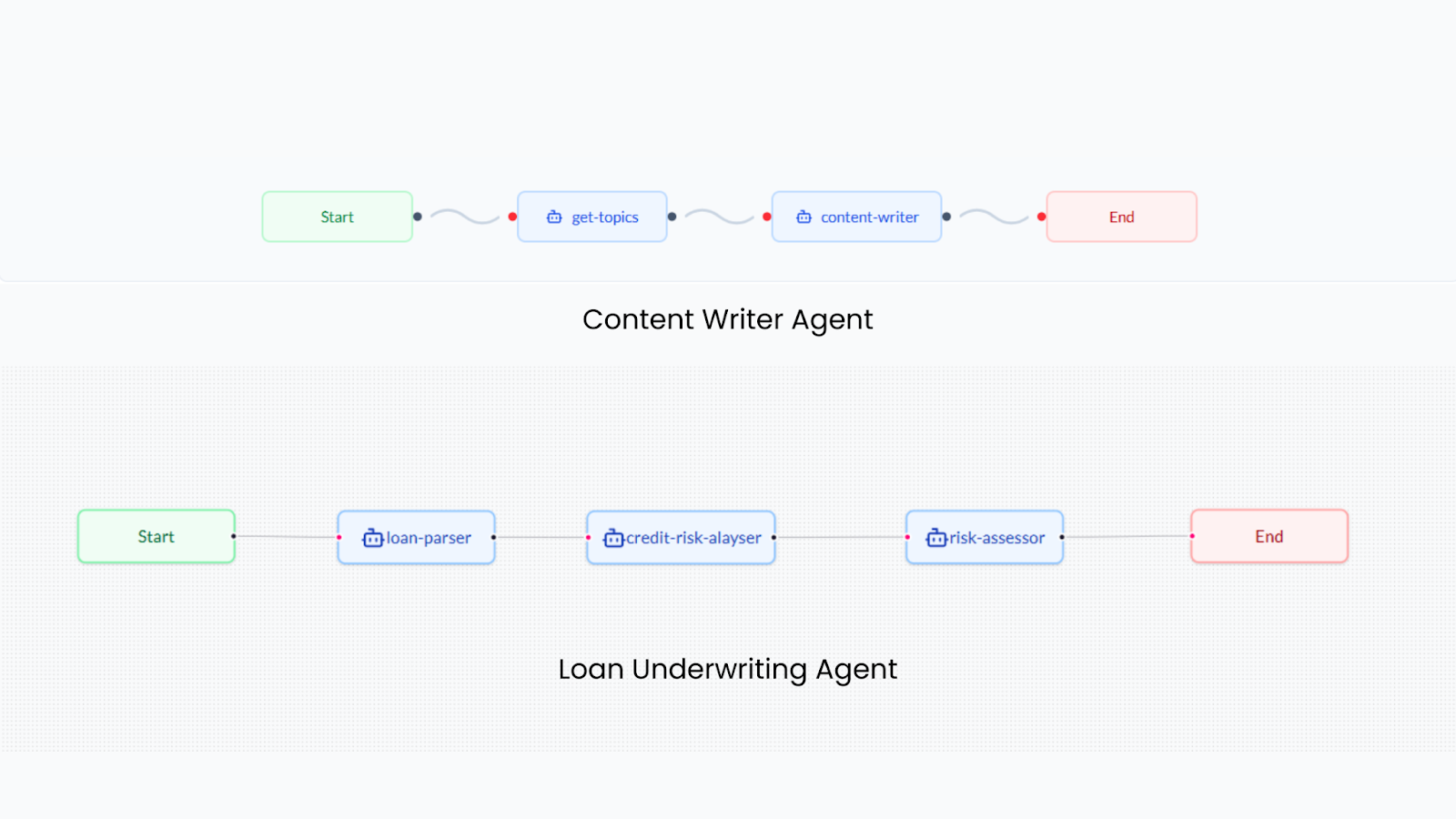
This is where many teams make the wrong assumption. FloTorch’s Hybrid Visual Builder is not a basic no-code layer. It is designed to combine visual clarity with real configurability so teams can design, validate, and evolve agentic workflows without being forced into rigid extremes.
What “hybrid” actually means
With the Hybrid Visual Builder, teams can:
- Visually design agent flows, tools, and evaluation steps.
- Configure prompts, parameters, and policies
- Model complex agent interactions—not just linear chains
- Iterate quickly without touching application code.
At the same time, workflows remain structured, reviewable, and testable.
Who this is built for
This approach works especially well for:
- Product and QA teams validating agent behavior.
- ML teams are experimenting with agent strategies.
- Founders and leaders who need visibility
- Cross-functional teams collaborating on GenAI systems
Why teams start here
- Fastest time to value
- No engineering bottleneck for iteration
- Agent logic is visible and explainable.
- Ideal for experimentation and structured validation
Hybrid Visual Builder takeaway: Choose a Hybrid Visual Builder when you need speed, clarity, and collaboration without sacrificing rigor.
A Clear Comparison
Most Teams Don’t Choose One - They Evolve
In practice, teams evolve beyond a single integration approach as their systems and needs grow.
A common progression looks like this:
- Start with the Hybrid Visual Builder to design and validate agentic workflows.
- Use APIs to integrate evaluations with internal systems.
- Adopt SDKs for production-scale automation.
FloTorch is built to support this evolutionary adoption, so teams do not have to over-commit too early.
Final Takeaway: Choose for Today, Stay Flexible for Tomorrow
There’s no single “right” integration for every team.
- SDKs are best when production control is your top priority.
- APIs are ideal for system-level integrations where scalability and reliability matter.
- Hybrid Visual Builders excel when speed, clarity, and collaboration across teams are most important.
FloTorch is designed to support that journey, step by step.
Schedule a personalized 1:1 demo with our experts → https://www.flotorch.ai/contact-us.