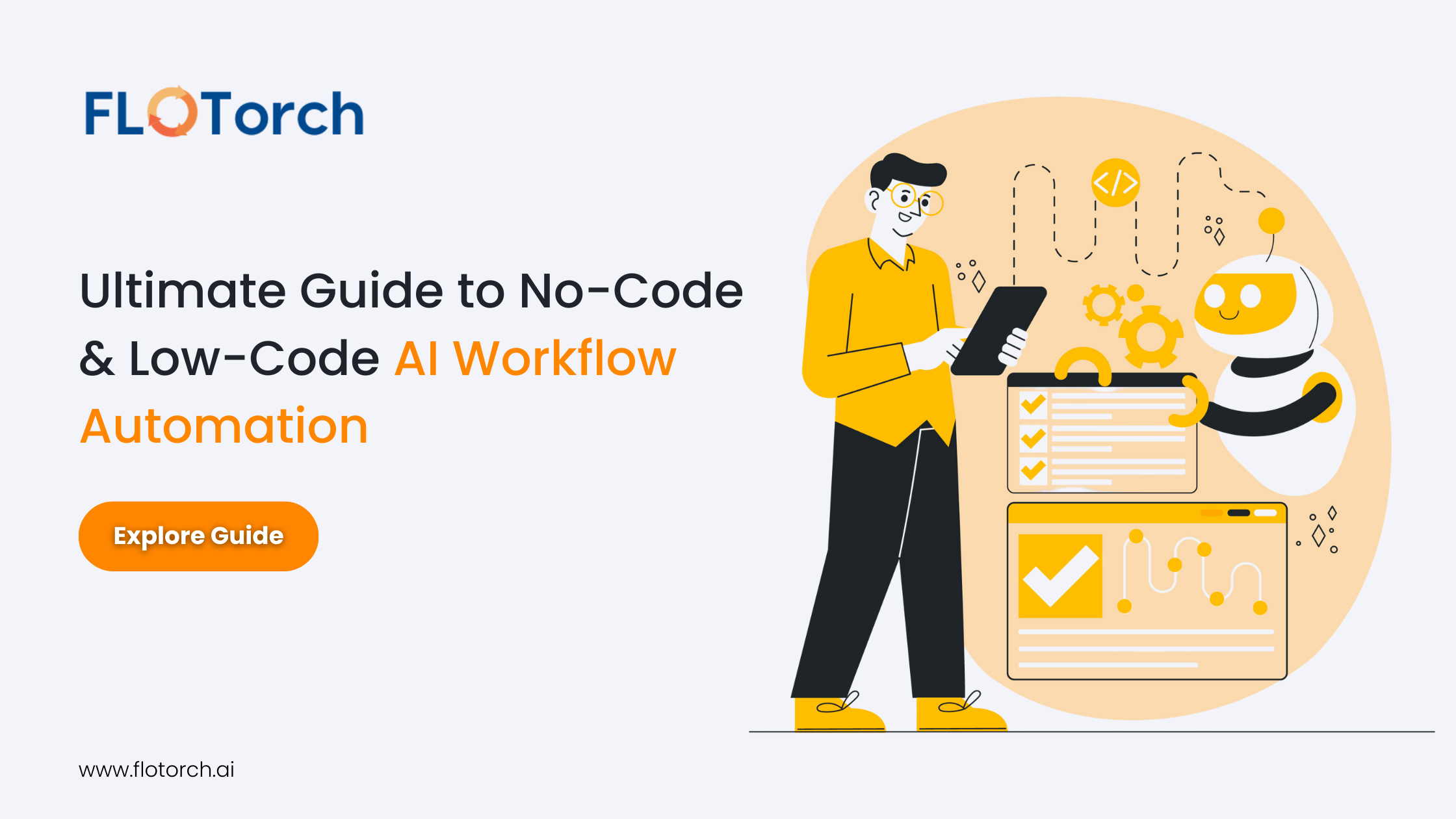

Introduction: Why No-Code & Low-Code AI Automation Matters Now
Enterprises today are dealing with rising operational complexity, shrinking budgets, and pressure to innovate faster. This is exactly why no-code AI tools and low-code AI workflow automation platforms are becoming essential. These tools allow teams to build, automate, and scale AI workflows without heavy engineering effort.
What used to require months of coding can now be achieved in days — enabling business users, analysts, marketers, operations teams, and non-developers to build powerful AI automations.
At FloTorch, we see this shift as the democratization of AI, where every employee can participate in building intelligent workflows safely and efficiently.
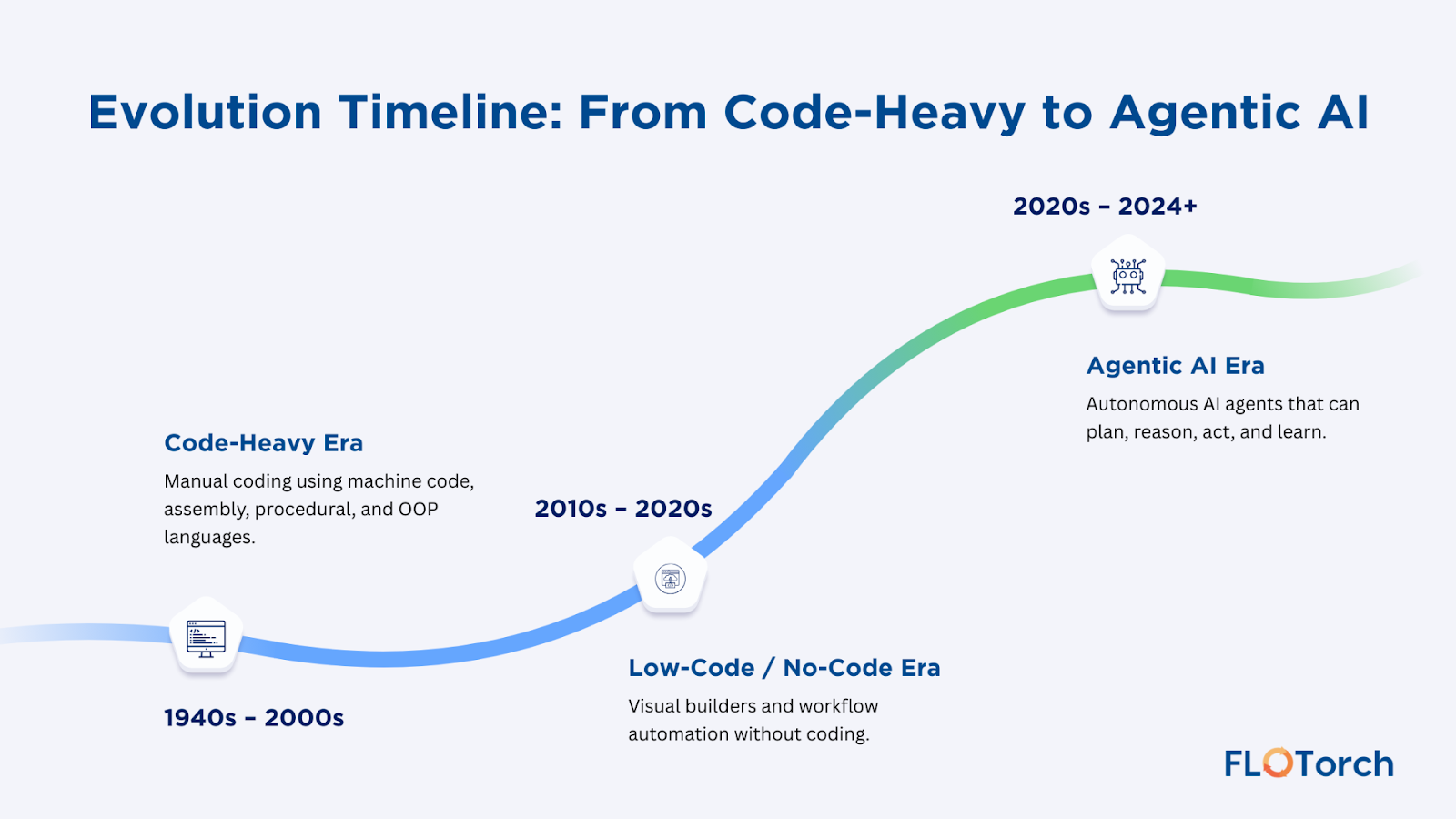
From Code-Heavy to Code-Light: The Evolution of AI Automation
Traditional workflow automation relied on engineering teams writing scripts, maintaining APIs, and building integrations manually. This approach no longer scales.
Today’s shift looks like this:
No-Code AI Tools: Allow business users to build workflows using drag-and-drop blocks, templates, and prebuilt AI modules.
Low-Code AI Workflow Automation: Enables deeper customization with minimal code — ideal for technical teams that need flexibility.
AI Automation Without Coding: The emerging category where AI handles orchestration, logic, and decisions without requiring scripting.
This evolution is accelerating AI adoption inside enterprises, making automation more extensible, scalable, and accessible.
Benefits: Why Enterprises Are Choosing No-Code & Low-Code AI Automation
Enterprises adopting no-code and low-code AI automation are realizing benefits far beyond productivity:
- Agility at Scale – Deploy workflows in days, not months, and pivot as business needs evolve.
- Workforce Empowerment – Put AI in the hands of business teams, reducing reliance on scarce developer resources.
- Governed Innovation – Enterprise platforms ensure guardrails around security, compliance, and observability.
- Future-Proofing – As AI agents and generative capabilities mature, workflows become more autonomous and intelligent.
The organizations that master this shift won’t just move faster — they’ll redefine operational models.
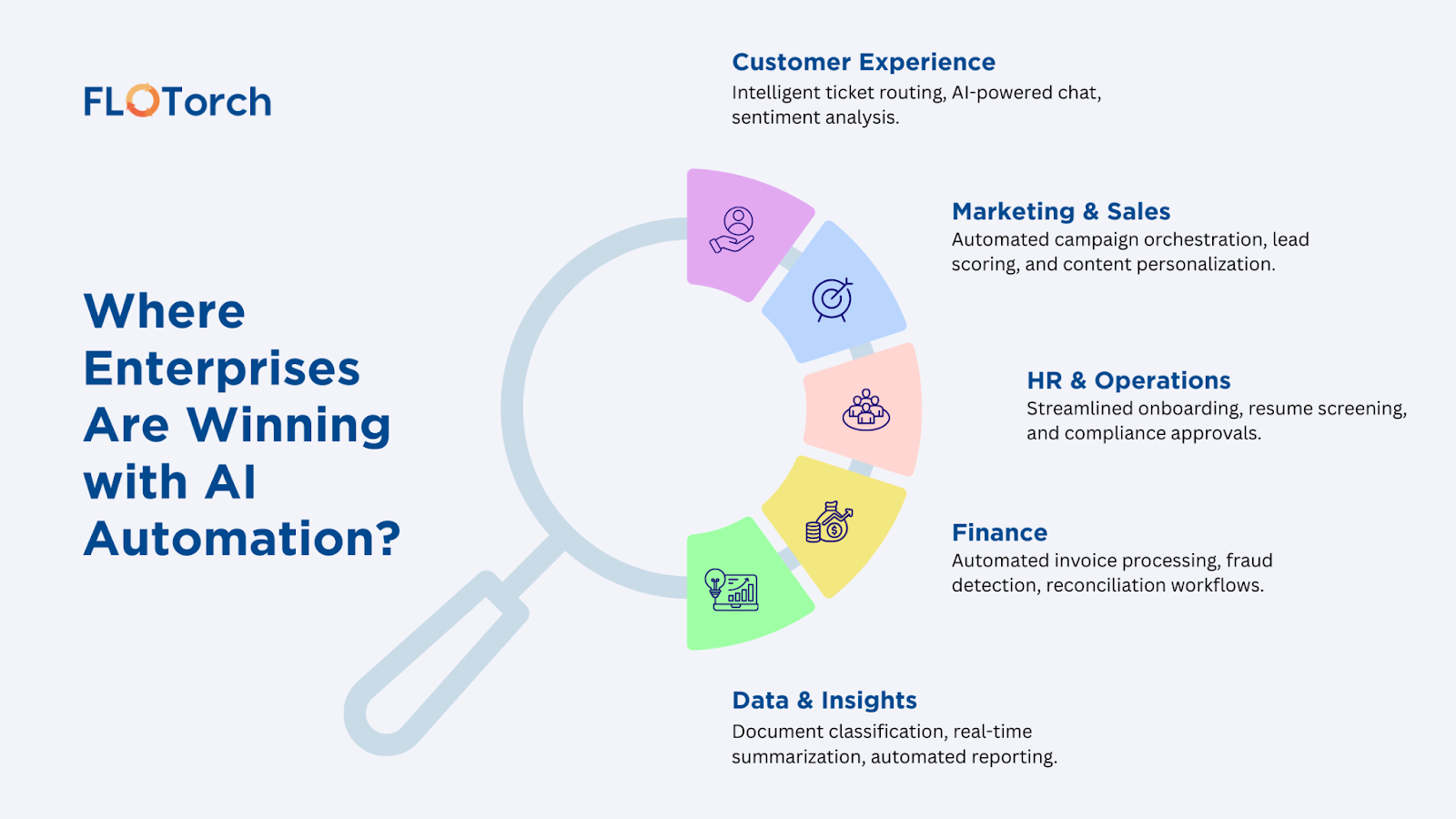
Where Enterprises Are Winning with AI Automation
We’re seeing adoption accelerate across industries:
- Customer Experience: Intelligent ticket routing, AI-powered chat, sentiment analysis.
- Marketing & Sales: Automated campaign orchestration, lead scoring, and content personalization.
- HR & Operations: Streamlined onboarding, resume screening, and compliance approvals.
- Finance: Automated invoice processing, fraud detection, reconciliation workflows.
- Data & Insights: Document classification, real-time summarization, automated reporting.
Each use case builds confidence — and creates a compounding effect: once one department sees results, others want in.
Choosing the Right Platform: Beyond Features
The landscape of no-code AI tools and low-code AI workflow automation platforms is crowded. Zapier, Make, n8n, Microsoft Power Automate, Automation Anywhere, and enterprise-focused players like Wizr are all competing for attention.
But leaders must evaluate not just features — but fit:
- Integration Depth: Does it connect to your existing ecosystem of apps and data sources?
- Governance: Can you manage permissions, track changes, and enforce compliance?
- AI Maturity: Does the platform natively support LLMs, custom AI models, RAG pipelines, Agentic orchestration, and plug-ins?
- Scalability: Will costs balloon as workflows grow, or can it handle enterprise scale sustainably?
- Vendor Trajectory: Is the platform evolving toward agentic AI workflows, or is it still anchored in basic task automation?
The winners will be those who balance ease of use for business users with enterprise-grade control for IT.
Building a Culture of AI Automation
Technology is only one side of the story. To unlock real value, enterprises must also build a culture around automation-first thinking:
- Identify champions inside departments who can own and scale workflows.
- Start with visible wins—quick automations that deliver tangible time savings.
- Measure impact relentlessly — hours saved, errors reduced, customer satisfaction improved.
- Embrace human-in-the-loop design for sensitive decisions. Automation should augment, not replace, human judgment.
Automation is not about reducing people — it’s about elevating people to focus on higher-value work.
The Road Ahead: From Workflows to AI Agents
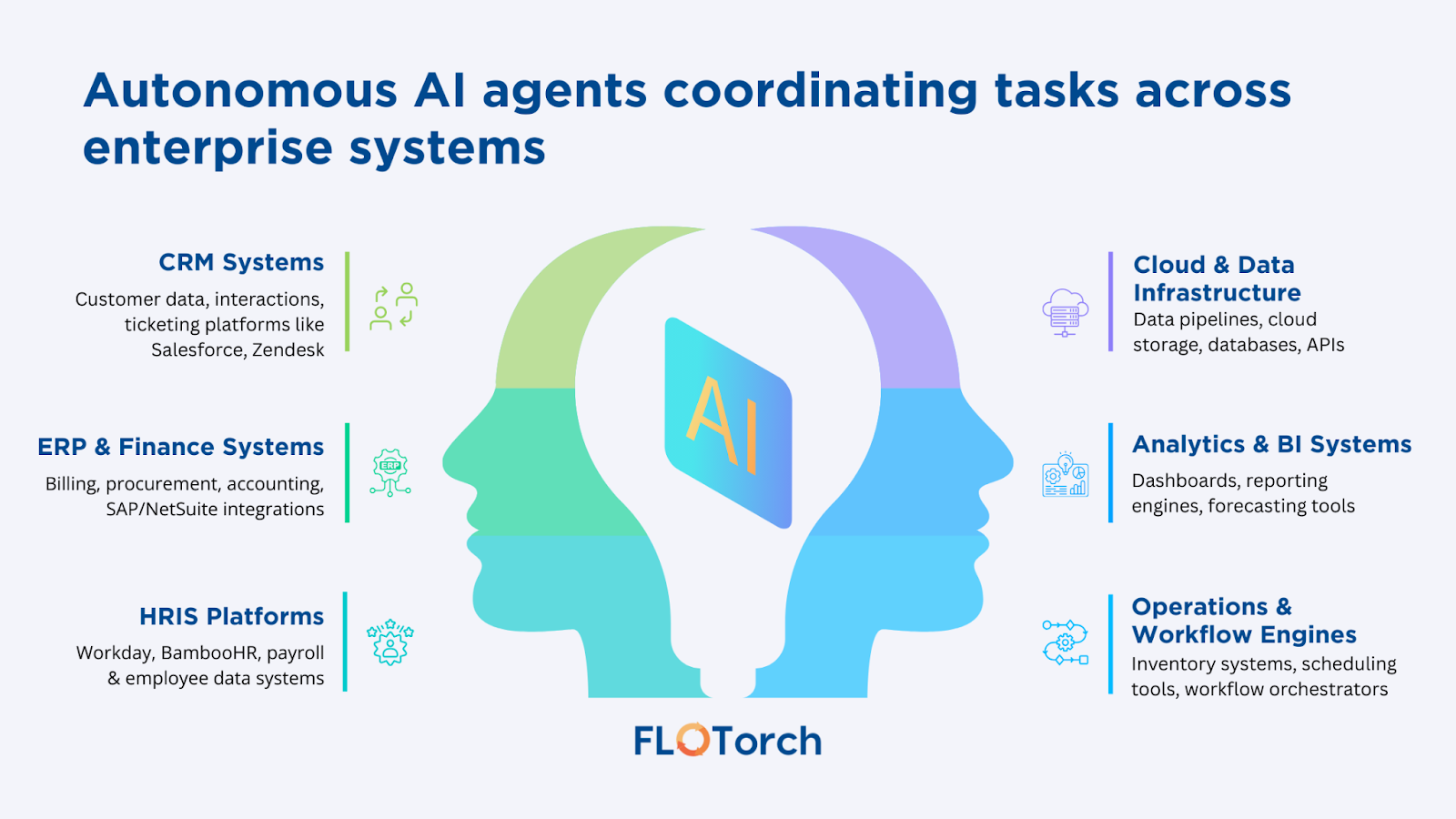
We are at the beginning of a shift from static workflows to adaptive AI agents. Soon, automation won’t just follow rules; it will make informed decisions, learn from feedback, and orchestrate complex processes autonomously.
Forward-looking enterprises are already experimenting with agentic workflows — combining no-code tools with AI models that plan, reason, and act. Platforms like FloTorch are preparing for this reality, ensuring enterprises can innovate securely, with governance and observability built in.
Conclusion: A Call to Leaders
No-code and low-code AI workflow automation is not a passing trend. It’s the new operating system for modern enterprises.
Leaders who lean into this shift will free their teams from repetitive work, accelerate innovation cycles, and establish an automation culture that compounds value year after year.
At FloTorch, we believe this is more than technology — it’s a mindset. The question isn’t “Should we adopt no-code and low-code AI automation?” The question is “How quickly can we embed it into the DNA of our enterprise?” Because in the era of AI, speed is not just an advantage. It’s survival.